Friday, December 31, 2010

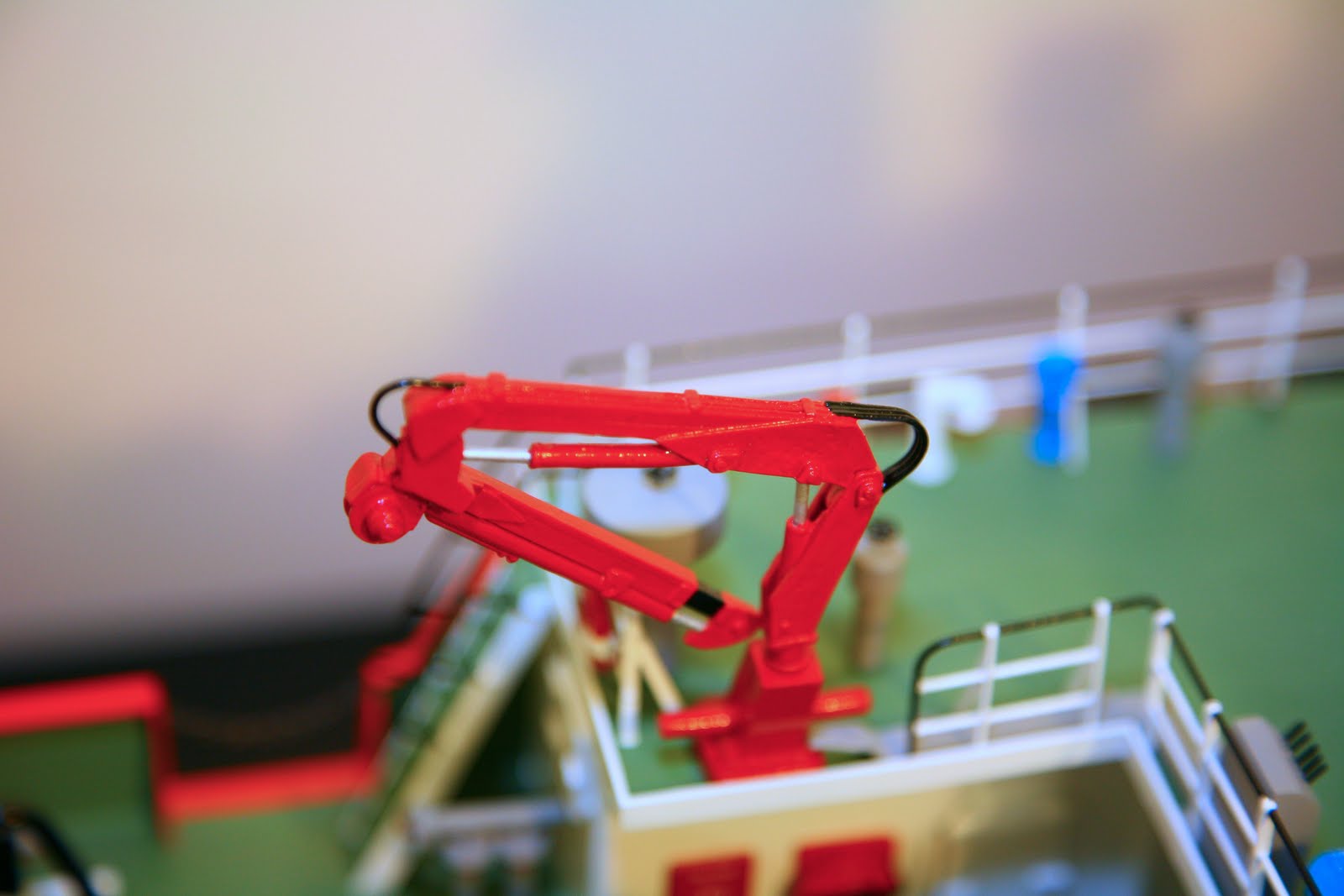
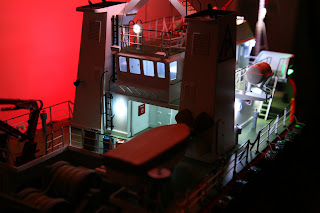
Here is a picture of the model that I am building
The build pictures start at the bottom of the page and work upwards. The date of this picture is in the future to ensure it appears before the other posts. The latest entries are just below this picture ...

Saturday, July 11, 2009

Here are the two eyes on the mast to take the rigging. These will be white, the same as the mast, so should blend in.
Here are the eyes for the rigging on the top of the bridge. These will be the same colour as the deck so they will hopefully blend into the floor when painted later.
Here is the pipework made and assembled. It is shown upside down in the photo, showing the standoffs which are in the right place for the holes drilled in the top of the bridge.
I have decided to add some detail to the tables and console used in the bridge. I have added grab-rails to each item and painted these black. I have also trimmed the long table and console to size.
I have made some boxes for inside the bridge to hide the wiring for the lights

Thursday, July 02, 2009

Here is the emblem added to the funnels. These are removable for spraying and painting as with other parts.
This is the plan of the pipework that I will need to make.
Here you can see the standoffs for the pipework (which feed the fire tenders). I have drilled the holes and placed them in the holes without gluing. I will use these standoffs as a guide for making the pipework, which can be glued to these and removed as one piece for spraying the superstructure and painting the pipework.
The spotlights on top of the bridge. I have added leds to these so that they are working lamps. There are two small holes behind the spotlight fixing for the led wires and the leds will be connected on the inside of the roof with connectors used for other parts of the wiring shown previously. You can also see the horn stand in this photograph. None of these parts are glued into place so that they can be removed when spraying the superstructure.
Rear floodlights on the rear of the bridge.
Front floodlights (non-working as supplied with the kit)
I have fitted the lights for the bottom of the superstructure (these are additional to the plans given with the kit)

Sunday, June 28, 2009

The leds were not light enough for the bridge internal lighting, so I used two of the sockets I bought for the other leds, superglued together and soldered the relevant connecters together, in order to house three of the leds that I have.
Stanchions added to the mast
I have added the crows nest supports

Tuesday, June 16, 2009

The mast with the crows nest attached.
And the lower radar in place
The radar fixed into place on the crow's nest.
Because of the 3mm leds' sensitivity to heat (or my bad soldering technique), I bought some turn-pin 0.1 inch sockets to solder up, so that I can just push the led into place. That way, I don't blow up any leds and they can be disconnected for maintenance. The led here has longer leads than I am going to use because I was just testing the loom.
Today I made some of the bridge wiring looms and tested them with leds

Wednesday, June 10, 2009

A closeup of some of the mast lights. The connections beneath the leds are a little messy but I will try to put a cowling around these to hide the wiring. Overall, a very difficult job to install these lights, but then, I am not doing this because it is easy !
Mast lights fitted and working. The 3mm leds used were fragile and sensitive to heat when soldering these to the wiring loom.
Rods fitted to the radar masts to aid fitting to the platforms.

Sunday, June 07, 2009

The middle platform added and wiring added for the lights. Top right, the radar sweeps fitted together

Saturday, June 06, 2009

The mast, part assembled with leds glued in place
The leds fitted to the light stands and above, the radar arms and motors (filled ready for sanding).
And that the red led is actually red ... you get the idea.
Testing that the white led is actually white, before I superglue it into place

Thursday, June 04, 2009

Here are the mast parts laid out together to give some idea of the final shape of the parts. The leds will need to be added before final assembly of the mast and stand.
I am quite pleased with the result of the steps on the mast.
The mast with the ladder and steps added.

Sunday, May 31, 2009

Here are all of the mast parts being prepared for assembling and painting. The ladders are top left (filled and ready for sanding) and the brass lamp bracket for the top of the mast is top right. This latter part is also conductive so has the led shorting issue outlined earlier. I am yet to sort out a way of fixing the leds to this part.
The crows nest with railings fitted after being bent to shape. The bottom shows the intricate shape that I had to cut from the (printed) plastic card.
Here's a thing... The mast lighting brackets are made from white metal which is, of course, conductive. The wires for the leds would short out when they passed through the bracket. To get around this, I have drilled 4mm holes in the brackets so that the led covers fit snugly . I will glue them in place and the leds will snap into them, whilst being isolated from the metal by the led cover.
And started drilling the holes in the mast for the climbing rungs to fit
I have added the steps up the mast supports.
I have added a hole to accommodate the lighting wiring from the mast. It will go down the mast stands and into the funnels before finishing in the hull of the boat.

Tuesday, May 19, 2009

Platforms for the mast.

Wednesday, May 13, 2009

Here is the two mast stand parts assembled and loosely placed with masking tape.

Saturday, May 09, 2009

Here you can see the holes for the navigation light wiring. This will visible but underneath. I may add some small boxing to hide the wires. I will see how it looks when put together.
I have added the mast stand brackets to the funnels. You can see the one on the port side with the hole to accommodate the wiring.
The mast with the brass rod attached (less the wiring) and filler applied ready for sanding.
At the front of the mast is a dowel. I have replaced this with brass rod in order to accommodate the wiring for the mast lights. In the picture above, you can see the wiring that I installed to test that the holes were big enough to take the wiring used.
The mast stand parts prepared and the mast being assembled below.

Friday, May 08, 2009

Today I assembled the life bouy frames from the white metal parts and cut brass rod.

Thursday, May 07, 2009

Added the ladders at the rear and on the funnels plus the hand rails too.
Looks the same as the photo before doesn't it ?
I just took it to show you that I removed the life bouy frames from the railings as they were looking a bit messy. I plan to tie the life bouys on when it is painted fully.

Wednesday, May 06, 2009

Added the life bouy frames today and started the ones on the rails (see top of photograph)

Monday, May 04, 2009

Today I have also added the stairs to both sides and railing. I have added a stanchion on the right hand side to support the rail. A stanchion was shown on the photograph of the boat on the front cover of the instructions but not on the plan.
I have added the rear watertight door on the superstructure

Sunday, May 03, 2009

Here you can see the steps handle which has been left long and needs setting to the right angle when the steps are in place.
There were some arkward bits...
I have fitted the railings for the lower superstructure. The steps need to be added next and the rails positioned to match their angle

Sunday, April 26, 2009

The front railings are now in place. Some of the holes need to be filled as they were elongated to ensure that the railings were level.

I have now added the brass parts and the watertight doors to the funnels

Monday, April 13, 2009

This is the front of the superstructure showing the skirting added (before tidying up) and the 3 additional items including the vent.
Here is the skirting added to the rear of the superstructure. Just needs cutting and tidying up at the corners and edges.

Saturday, April 11, 2009

More of the skirting is fitted to the superstructure. Ends will be cut and tidied when all pieces are in place and dry.
Here I have added some of the fittings to the superstructure because no skirting is being installed where these items are. The vent will also have to be placed before the front skirting is finished, but this proved to be too short, and I have added a piece as discussed in the previous post. The masking tape on the desk is so that the skirting does not stick to the desk, like when I added skirting to the bridge.
This shows the additional ladders being filled after cleaning up, the extension to the vent because it was too short and the mast supports, one with a hole in in to accommodate the wiring from the funnel, as discussed below. I have added a bottom piece to the mast supports in order to hide the wiring. Both pieces will need filling and cleaning up later.
Here you can see the hole I have made in one of the funnels. This is to accommodate the wiring to the navigation lights in the mast. The markings show where the mast stand will be, so covering the hole.

Thursday, April 09, 2009

Here is the bridge skirting completed. You can see the small skirting where the doors go. This was not on the plans but there is no gap around the bridge now and I think it looks better.
and here is the skirting in place, thus hiding the small gap beneath the rear of the bridge.
Here is the piece of skirting that I had to make so that it would fit around the supports of the rear bridge platform.
The position of the door fittings were marked, which is where I will fit a thinner skirting in order to allow for the doors when added.
I marked the exact position of the bridge and put masking tape over it, so that the glue on the skirting would not stick to the rest of the superstructure.

Sunday, April 05, 2009

Here is the bridge with the railings and ladders in place but not glued as they will need to be removed before spray painting. In the foreground you can see the skirting that I am going to use around the bridge, as discussed on the previous photo below.
There is a small gap at the rear of the bridge as the superstructure beneath this drops slightly. Rather than try to raise the superstructure underneath, which is attached to the funnels and other parts, I think I will add a skirting to the bottom of the bridge, either just at the back or all of the way around.
Here are the stanchions loosely fitted to the bridge support superstructure. I will superglue these into place .

Thursday, April 02, 2009

Making the ladders from white metal parts. These two were cut from one ladder and cleaned up. The ladder brackets (which the holes in the bridge will be for) are made from etched brass.
Here I have / or am in the process of drilling the holes for the fittings.

Tuesday, March 31, 2009

Marking it out on the model and drilling the holes.
Working it out on the plan. Measurements for some of the stanchions.
The overhangs filled after tidying up the corners. Ready to sand when dry.

Monday, March 30, 2009

Here are the custom made decals I bought from becc via www.modelflags.com . The numbers at the bottom are the samples that they sent to me to test before buying. I prefer these to the included decal "transfers" and I have also purchased 1:50 hull markings to match. The decals are waterproof when fitted - I tested on the trial numbers sent !
Here are the white metal lighting parts to fit to the bridge. I plan to add all parts that can be sprayed white, then add the other parts after spraying.
The overhangs at the rear of the bridge to tidy up too.
Here are the deflectors sanded and the overhangs added. These will need tidying up

Friday, March 27, 2009

Here is another one of the brass parts, the rear bridge platform, fixed in place by the integral 0.7mm pins.

Thursday, March 26, 2009

And filler for the gaps, as the deflectors are at an angle. I will sand when the filler is dry.
Here you can see the deflector supports that sit behind the deflector sheets.
By contrast, the deflectors around the rails were very difficult to fit so that it looked right.

Friday, March 13, 2009

The railings on top of the bridge have been completed. This is quite awkward to do but not as difficult as I thought it would be. I used super glue instead of soldering and the result seems quite good

Thursday, March 12, 2009

Loads done since the last photo. Bridge built, stanchions added after filling and sanding the outside of he bridge, the funnels and the framework around the navigation lights. I have also remade the parts melted by the filler in the previous post to the blog.

Friday, December 28, 2007

The template in the instructions was traced and taped to the wheelhouse roof. I then drilled 7mm holes in the correct locations.
I have now completed the control desk which was much more successful than the fittings discussed previously.
I have an earlier post saying that the filler that I use is good, but melts plasticard if used carelessly. I used the filler to fill a couple of the lower superstructure parts, so that they would be stronger for sanding and filling. However, I put too much in at once and the heat produced melted the plastic. I will have to remake the parts.

Monday, December 24, 2007

The shape made from the spatial awareness test! This needs filling and sanding.

One of the fittings to be made of plasticard, otherwise known as "the spatial awareness test"

The edging, showing the overhang so that I can sand to the exact shape of the superstructure that it fits to.
Here I have finished the housing for the navigation light and started to fit the edging to the upper part of the lower superstructure

I have cut the port holes in the lower superstructure. The white metal fittings will hide the slightly rough cuts I have produced.

Thursday, December 13, 2007

And the green starboard side light. The green cap is slightly different to the red lamp so I have purchased another one which is better
Fitting the port side light
Keeping Tamiya (paint department) in business!
Painting the doors (custom built), captain(!) and screens
Adding the instruments on the control panel.
Most of the inside of the bridge is now painted as shown above (with dust from sanding!)
modifying the funnel trim. The starboard side trim was thinner than the port so I have added a strip of plastic card. I will tidy it up when the glue has set

Friday, November 30, 2007

Another experiment. Which colour for the deck? The photo does not do it justice but the darker green is very dark. I think I might go for the lighter "cockpit green" colour.
Painting the furniture with a custom colour - using mid grey and white. The piece at the top is an experiment to see which colours look the best for the fake stairs in the bridge.
Here are some of the furniture items with a figure from the kit to show scale.
The detail in the bridge will include (fake) stairs and bannister.
As there is no detail inside the bridge included with the model, I have decided to design and build some furniture and control console. All pieces are to scale although I have guessed what the bridge would look like.
The floor of the bridge structure has been painted. See the white mark? That's where I put something on it to test that it fitted ... before the glue was dry! Doh! sandpapering and recoating shortly!
As the inside of the bridge will be inaccessible when assembled, I have started to paint the inside of the bridge walls. The front and rear section needed to be bent to the shape of the side pieces. Some of the window frames snapped during this process as they are quite thin. In the picture here, you can see that I have glued and filled the resultant gaps in the frames.
There is no yellow cap available for the yellow led, so I bought a white one and painted it with Tamiya clear yellow paint. Here it is after one coat. I will give it another coat.
Here is a close up of the leds and a white and red cap.
I have purchased the leds for the lights on the boat. They are 3mm (superbright type) with coloured caps as the leds are "water clear" making them look more like lights than leds. They were very expensive (for leds) but they look right for the boat. I have also purchased the wiring for the boat. I chose white and grey colours for + and - as they are easier to hide than red and black (for instance).

Tuesday, November 20, 2007

Here is the bridge accomodation taped together to see if the cut parts fit. I am going to put detail in the bridge and rear room which is not included in the kit. I am currently considering some different designs.
I've put the rear deck cover in place. At least it looks better than the view of the bottom of the hull that was there before.

Sunday, November 18, 2007

Holes cut to route the wiring. At this point there will be many cables, so I have made these holes quite big. The cables will be hidden by the additional parts to be added to the superstructure.

The base for the navigation lights. I have not decided which way the wiring will go for the working navigation lights, so I will not add the complete housing yet.

I have added the trim to the top of the funnels

Sunday, November 04, 2007

The superstructure has been filled and I will sand smooth when dry. The above photo shows the next parts ready to fit to the superstructure / bridge and funnel finishing strips (bend pieces).
Here is the bent piece in more detail. The cutout will house a navigation light either side. I made the housings slightly wider to accommodate the leds that I am going to use as lights
Here the front of the bridge base is fitted. The sides are bent around to fit the structure as shown in the picture above
I have attached the funnels after modifying the base for the front inside edge of each funnel to fit correctly

Thursday, August 16, 2007

The funnels "placed" in order to test that the fit is good. Wow, do you think it might look like a boat one day!?

The funnelstaped together to test that the fit is good

Strengthening to the roof as there is a bit too much "give" if weight is placed on the roof.

This shows the 6x3mm strips I used to joint the parts together

Fitting the base in situ.

On to the base of the superstructure. This has to be built in place to ensure it fits over the frame made earlier in the project. This will allow access to the bow-thruster and any electronics fitted near to it. That's if I ever get around to kitting it out with remote control gear, that is.

After successfully testing the stickers I plan to use for the name of the boat and hull markings on varnished paint, I decided to spray varnish the hull at this stage. Here is the boat masked up and ready for spray varnishing. The port holes for the anchors have been fitted. After several coats of varnish, there is little difference. This is good, I suppose, but it does mean the hull is less easy to scratch (this is what I found from testing a spare piece of plasticard).
Here are the holes for the anchors from the bow of the boat.

Wednesday, August 08, 2007

Here I have added the bling! These are the anodes on the rudders and kort nozzles.
and painting the anchors too.

Painting the port holes for the anchor
Scary! I forgot to cut a hole in the hull for the anchors, which I now cut after I have painted it. Worked out OK 'though.

Sunday, July 15, 2007

And here is the bar linking the servo arm for the rudders. This enables one servo to move both rudders equally.

Here are the rudders completed with the bottom guides glued in place. Actually there is a little tidying up to do that you cannot see here.

Sunday, July 08, 2007

As some of the clean up exposed bare metal, I have re-painted some primer on the rudder bases.
Here is the rudder close up showing the excess glue that needs to be tidied up.
The rudders fitted. You can see the bottom rudder guide was broken off when I bent it to one side like the one attached. I bend it once too many times and it broke off. These guides will need to be glued anyway so it does not matter
The propellers have been polished and attached to the shafts. The shafts were then greased and inserted into the shaft tubes. This is because it will be difficult to fit them when the rudders are on.
I have glued the two halves of each rudder together with epoxy, filled, sanded and painted with primer. The shafts have been sanded where the rudder will glue to the shaft and the rudder servo attachments now have a link to ensure both turn together when attached to the servo. The dowels you can see were used to hold the rudders while painting.

Monday, May 14, 2007

Testing paints and suitability to paint over other types of paint (enamel / acrylic / spray paints). I will also test the effect gained when painting thinned varnish over the spray paints as the instructions suggest, to ensure I am happy with it

Monday, April 09, 2007

I am pleased with the finish in general. I will need to match a colour to touch in the inside of the balwarks and tidy the waterline, but I am going to leave the paint to completely dry over the next few days first
Some slight (expected!) overspray through the port holes etc. The inside of the balwarks will need touching in too.
Here is a close-up of the waterline. I am generally pleased with it but it will need tidying up in places (see the right hand third of the photo - there is some overspray).
And here is the hull with the masking removed after many coats of paint. I masked slightly short of the red oxide primer added earlier, to create a white waterline.
Here the bottom of the hull and the decks are masked off and I have started spraying the red colour of the upper hull. Lots of coats needed as the paint is very thin.

Wednesday, April 04, 2007

And the stern. I have since added another coat of paint or so as the kort nozzles are not quite covered here.
And here is a close-up of the bow
The finished bottom of the hull, sprayed with red primer
As the bow thruster will be hard to spray, I have given it one coat of paint with a brush in case it does not cover fully. I used the spray can, spraying some into a glass jar and thinning with white spirit (as it dried too quickly to work with otherwise).

Thursday, March 29, 2007

And here is the boatstand that I have made for when the hull has had it's coats of paint
Here is the boat after being washed in soapy water to remove any static, ready for painting

Wednesday, March 28, 2007

The waterline was marked by leveling the boat and then modifying a cutting compass with a drill, to hold a piece of lead.
There are a few places to tidy up before the boat is ready to paint. After sanding, I will wash in soapy water to illiminate any static build-up ready for painting
Tidying up the opening and the balwarks, you can see the water line here that I have drawn. How I did this is explained later
And here are the balwarks and supports fitted and sanded.

Sunday, December 31, 2006

I have decided to re-fill the gap between the rear deck and rear bulwarks again for a better finish. Meanwhile, while I wait for the filler to dry, so that I can sand it smooth, I have cut all of the pieces required for the rear deck bulwarks. For some reason, two pieces (one from each side of the boat) are too short. I will make some longer ones from spare styrene.
I chose to use small pieces of styrene, cut and sanded to complement the shape of the roller. I will fill and sand for a good join.


The manual suggests finishing the radius of the roller where it overhangs the stern with filler or small pieces of styrene.
Here is the cable roller in place

There was very little edge with which to glue the cable roller, so I added some styrene strips which had the benefit of making the moulding more rigid .


Time to cut the cable roller for the very rear of the stern. This is made from vacuum formed plastic.


Thursday, December 21, 2006

I have now assembled the support uprights - a fiddly task! The supports near the cutouts are also my own design, modified from the kit's original pieces. Bottom left of the picture is the small set square I used to ensure that the supports were upright.
This is one of the cut outs in detail showing the modifications
Here you can see the cut outs that I modified to look like the real vessel (ie: they have 'angled' uprights)
The top edging of the bulwark supports are added to the bow

Monday, December 11, 2006

And here are the foredeck bulwark parts cut out ready to be fitted and sanded to the final shapes.
This is the mess I have made of the filling around the bow. I will be refilling and sanding when the new filler (Plasto) has arrived that I have ordered. Beware this filler is good, but "melts" the plastic card if used carelessly. Meanwhile I am going to start cutting out the extra parts for the front of the bow...
And here is the bow showing the bridge etc. guide fitted. The bridge etc. will fit over this part to allow access to the bow thruster and any electronics that are in that part of the boat if and when fitted. I have sanded the deck and other parts with very fine sandpaper for a good finish.

Thursday, December 07, 2006

This is the upper deck fitted and filled. You can see various points where I have added more filler as shown in the close-ups below. I will sand this smooth when dry and inspect to assertain if I need to fill any more.
And a little more around the bow.
I filled the gaps in the edges of the upper deck and sanded smooth. Here I have added a little more filler where there is not enough.

And here is the upper deck fitted. Just required filling now.
This is a view from the front of the bow of the finished upper deck supports

Saturday, December 02, 2006

I did not want to just glue the frame that holds the bridge etc. just to the end of the plastic card of the upper deck as I thought it would not be secure enough. I have added these supports underneath the upper deck. They will allow the frame that the bridge etc. sits on to be securely glued to something.
More support added and epoxy added to hull to ensure a good bond

Tuesday, November 21, 2006

And here are those parts fitted to the lower deck

Saturday, November 18, 2006

The bulkhead was assembled and strengthened using 3x3mm square plastic rod. The rod will also give more of an area to fit to the superstructure.
And here is part of the rear deck, fitted and gaps filled

Sunday, November 12, 2006


OK, after a bit of a break, back into the swing of things and the rear deck is secured into place, using anything possible to hold it in place while the glue sets

Thursday, May 04, 2006

More filling on the hull (small breakouts from when I cut the holes). Needs sanding smooth when the porthole filling is sanded .

Wednesday, May 03, 2006

Here is a close-up of the motor coupling.
Here I have made some wooden brackets for the motors and fitted the couplings to the shafts. The motors are fitted loosely to test for a good fit. Looks OK but I might tidy the brackets up a little.
I have added the mooring rings (see the bow) and the portholes have been fitted and filled around the edges to plug any small gaps. I will sand them when the filler has dried.

Sunday, April 16, 2006

I decided to fit the mooring rings today. I found that they were slightly too short for the thickness of the hull because of the filler that I added earlier. This called for some delicate work! In the picture above, you can see (top left) the original mooring ring. By adding short aluminium tubes to the end (bottom left and bottom right), I created a longer version (top right is a completed version). The ruler is there for scale.
Now, is the bowthruster tube watertight? I put the boat in the bath, filled with some water and weighed the bow down to submerge the bowthruster in the water. I left the boat in the bath for a day (we have a shower too) and there are no leaks whatsoever!

Thursday, April 13, 2006

Next I prepared the rudder servo levers. The rudder shaft had to have a piece cut from each to allow the bolt to go through. These will have to be in place before the rear deck is mounted, and therefore the propellers will have to be in place, as they cannot be fitted after the rudders are in place. I am thinking about how and when the running gear is to be primed and painted as the propellers are brass and I don't want to get paint on the part.
More front deck supports reinforcement in the form of a plasticard tab both sides and underneath the join
Reinforcement to the front deck supports has been added by surrounding the end of the beam with epoxy glue
Next I positioned the front deck supports after marking their position when the deck was loosely fitted.
The bowthruster tube filled and sanded around the edge

Saturday, April 01, 2006

This is the bowthruster tube which I need to trim and fill between the tube and the hull
The bowthruster has been assembled and expoxied in place with plenty of expoxy so it is water tight ready for use

Sunday, March 26, 2006

The bowthruster holes from inside of the hull
I have created the bowthruster holes after marking where the centre line of the supplied dummy bowthruster was to be fitted. I also marked the waterline to ensure it is below the water. This bowthruster is nearer to the front of the bow because of it's smaller width

Wednesday, March 15, 2006

Here you can see the difference in diameter between the supplied, dummy bow thruster (left) and working one on the right. Because the tube is shorter, I will need to position the bow thruster further forward than the plans show
I have purchased a working bow thruster from Robbe, to replace the supplied dummy one. Here it is in component form with the instructions. I will need to fit it quite soon while the bow section is still accessible

Thursday, March 02, 2006

Here are all of the rear deck supports in place. Let's hope that the added pieces do not get in the way of anything later on !
I thought that the front of the rear deck also had too little support. I checked the plans, and this seems to be the area that the main winch will sit, so I added 2 more pieces to reinforce the support, which you can see in this photograph
After completing the deck supports as shown in the plan, I placed the rear deck to see how it fit. I decided that the very stern of the deck was not supported enough, so I decided to add an extra support as you can see here

Monday, February 27, 2006

A close-up showing the deck reinforcements as suggested by the Model Slipway instruction book. I have also added so reinforcements of my own design at the point where the main deck supports intersect. I have reinforced the edges with epoxy. Everything sits on top of these supports so they need to be right
The deck supports are now in place, glued with either epoxy or liquid poly, depending on what it was being fixed to. You can see some of the reinforcements added at the point where the main and outer deck supports meet.
With the deck supports taped into place, you can see the position of the modification, just above the rudder shaft area, to allow the fitting of the servo control piece.
Using masking tape to tape the deck supports to the deck, I made sure everything fitted correctly. The deck needed slightly reshaping at the stern to get the piece to slot in
These are the rudder servo pieces that foul the main deck supports
Making the main deck supports. Here I have made a modification to the supports as I found that the rudder servo connection pieces fouled the supports. You can see the positioning of these pieces later on

Monday, February 13, 2006

Here is a close-up of the running gear. There is very little clearance between the props and the kort nozzles, so getting all the parts to fit together correctly was very time-consuming.
The running gear complete with kort nozzles and rudders. Props are also in place. The rudders are not yet glued as they will need to be removed when painting the kort nozzles so as not to get paint on the brass parts.
Here is the running gear part assembled -- The running gear is made of white metal parts with a brass shaft tube. The parts are fixed in place with epoxy .
A close-up of the outer deck supports at the bow
A close-up of the outer deck supports at the stern
Here the outer deck supports are in place. The higher level is seen at the bow of the boat
The stern with the running gear slots cut
A close-up of the bow of the boat, showing the parts I have cut out of the fibreglass hull.
This is the hull with most of the holes and segments cut. The inside top of the hull has been filled with Isopon P38 and sanded for a smooth finish. These parts will eventually be just above the decks, when the boat is finished .

Friday, January 20, 2006

The Hull as supplied by Model Slipway.
(Picture from Model Slipway's web site - see links)
The AZIZ kit as supplied by Model Slipway
Picture from Model Slipway web site (see links)